
Debt collection Dubai is an important legal and financial process for individuals, businesses, suppliers, and other creditors seeking to recover money owed to them. In Dubai, unpaid debts can arise from commercial transactions, personal loans, outstanding invoices, rental agreements, bounced cheques, and contractual disputes. When a debtor fails to meet their payment obligations, the creditor may have several options to recover the outstanding amount under applicable UAE law.
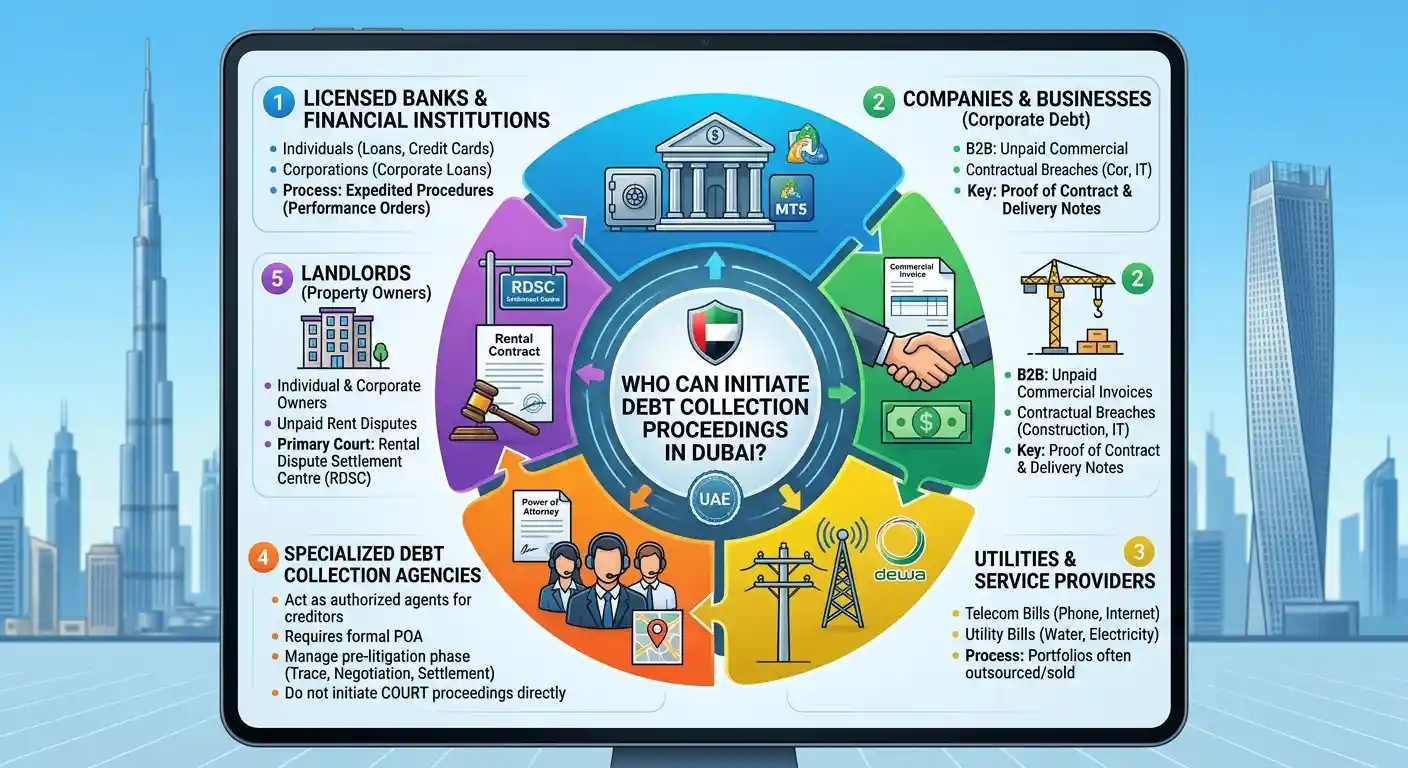
Debt collection Dubai can be initiated by a person or legal entity that has a legitimate claim to an outstanding debt. Depending on the circumstances, the creditor may pursue an amicable settlement, appoint a debt collection agency, instruct a lawyer, or initiate formal legal proceedings before the competent court.
Understanding who has the right to initiate debt collection proceedings is essential because not every person who requests payment is automatically entitled to file a legal claim. The claimant generally needs to demonstrate a legal interest in the debt and provide appropriate evidence supporting the amount owed.
This article explains who can initiate debt collection proceedings in Dubai, what documents may be required, how the process works, and when professional legal assistance may be beneficial.
- Individuals Who Are Owed Money
Individuals can initiate debt collection proceedings in Dubai when another person owes them money and fails to repay it according to an agreement or legal obligation.
Personal debts may arise from several situations, including:

- Personal loans provided to friends, relatives, or acquaintances.
- Money lent under a written repayment agreement.
- Unpaid amounts arising from private business arrangements.
- Outstanding payments under a valid contractual agreement.
- Other legally enforceable financial obligations.
For example, suppose an individual lends AED 100,000 to another person under a written agreement specifying a repayment date. If the borrower fails to repay the amount when it becomes due, the lender may consider pursuing debt recovery.
The lender should preserve relevant evidence, such as bank transfer records, signed agreements, written acknowledgements of the debt, and communications concerning repayment.
A claimant should also consider whether the debt is due, whether the borrower disputes the amount, and whether any limitation period applies. Where the parties cannot reach an agreement, the creditor may seek legal advice about filing a claim before the competent court.
Individuals do not necessarily need to operate a registered business to pursue a legitimate personal debt. However, the applicable procedure depends on the nature of the obligation, the available evidence, and the relevant jurisdiction.
- Businesses and Commercial Companies
Businesses are among the most common parties initiating Debt collection Dubai proceedings. Companies frequently provide goods, services, credit facilities, and other commercial benefits to customers who are expected to pay within an agreed period.
When customers fail to make payments, the affected business may seek to recover its outstanding receivables.
Businesses that may initiate debt collection proceedings include:
- Trading and distribution companies.
- Construction and contracting businesses.
- Real estate companies.
- Logistics and transportation providers.
- Professional service providers.
- Technology and IT companies.
- Manufacturers and wholesale suppliers.
- Hospitality and tourism businesses.
For example, a Dubai-based supplier may deliver products worth AED 250,000 to a corporate customer under a purchase order. If the customer receives the goods but fails to pay the invoice, the supplier may pursue recovery of the outstanding balance.
Before initiating proceedings, the company should collect the relevant purchase orders, invoices, delivery confirmations, contractual terms, account statements, and correspondence concerning payment.
A company generally acts through an authorized representative when pursuing a legal claim. Depending on the company’s legal structure and the applicable procedural requirements, documents establishing the representative’s authority may also be necessary.
Professional legal assistance can help a business assess the strength of its claim, determine the appropriate forum, and choose between settlement negotiations and formal proceedings.
- Suppliers and Service Providers
Suppliers and service providers can initiate debt collection proceedings in Dubai when customers fail to pay for goods delivered or services provided under an agreement.
This category includes businesses that supply raw materials, equipment, office supplies, consultancy services, maintenance, transportation, software, and other commercial services.
For instance, a marketing agency may complete a digital marketing project for a company in Dubai and issue an invoice for AED 40,000. If the customer refuses to pay despite reminders and the payment deadline has passed, the agency may pursue recovery through negotiation or legal proceedings.
To strengthen their claims, suppliers and service providers should maintain:
- Signed contracts or service agreements.
- Purchase orders and approved quotations.
- Tax invoices and account statements.
- Delivery receipts or proof of completed services.
- Emails and messages acknowledging outstanding payments.
- Records of payment reminders and settlement proposals.
In some cases, a supplier may have sufficient written evidence to apply for a payment order under the UAE Civil Procedure Code. This procedure is subject to specific legal conditions, including the requirement to serve a payment notice for at least five days before filing the petition. The appropriate route depends on the nature of the debt and the supporting documents.
- Landlords and Property Owners
Landlords and property owners in Dubai may initiate debt recovery proceedings when tenants fail to pay rent or other amounts legally due under a tenancy agreement.
Common examples include:
- Unpaid residential rent.
- Outstanding commercial rental payments.
- Unpaid contractual service charges.
- Other amounts recoverable under the tenancy agreement and applicable law.
For example, a landlord renting a commercial property to a business may face several months of unpaid rent. The landlord can review the tenancy contract, payment records, and relevant notices to determine the appropriate recovery procedure.
However, rental disputes are not necessarily handled in the same way as ordinary commercial debt claims. Depending on the parties, property, and nature of the dispute, the Dubai Rental Disputes Center or another competent forum may have jurisdiction.
Landlords should therefore establish the correct legal route before submitting a claim. A lawyer experienced in property disputes can help assess the unpaid amount, review the tenancy documents, and identify the appropriate proceedings.
- Financial Institutions and Lenders
Banks, financial institutions, and other lawful lenders may initiate debt collection proceedings when borrowers fail to meet their repayment obligations.
Outstanding debts may arise from:
- Personal loans.
- Business loans.
- Credit facilities.
- Unpaid credit card balances.
- Financing agreements.
- Other enforceable lending arrangements.
Before commencing proceedings, the lender generally needs to establish the outstanding balance and demonstrate the borrower’s payment obligations.
Relevant evidence may include the loan agreement, repayment schedule, account statements, payment history, and correspondence concerning default.
For example, a business that obtains financing from a bank but fails to repay instalments may face recovery proceedings in accordance with the financing agreement and applicable UAE legislation.
The lender’s available remedies depend on the type of financing, contractual terms, applicable security arrangements, and any relevant regulatory requirements. Where the debt is disputed, the parties may need to resolve questions concerning the balance, interest, fees, or alleged contractual breaches.
- Creditors Acting Through Debt Collection Agencies
A creditor does not always need to manage the recovery process personally. It may appoint a debt collection agency to communicate with the debtor, issue payment reminders, negotiate a settlement, and assist with administrative aspects of recovery.
For example, a Dubai company with numerous overdue invoices may appoint a debt collection agency to manage its receivables and contact customers who have failed to pay.
The agency’s authority generally depends on the service agreement and any applicable legal requirements.
An important distinction is that appointing a debt collection agency does not automatically transfer ownership of the debt. Where an agency is merely acting on the creditor’s behalf, the original creditor ordinarily remains the party entitled to pursue the underlying claim. The agency cannot assume an unrestricted right to file proceedings in its own name simply because it has been instructed to collect the money.
If the debt has been legally assigned or transferred, the position may be different. The validity of the transfer, the rights acquired by the new creditor, and the applicable procedural requirements must be assessed.
Debt collection agencies should operate within the authority granted to them and comply with applicable laws. They cannot create a legal entitlement to money that the creditor itself does not possess.
- Lawyers and Authorized Legal Representatives
Lawyers can assist creditors in initiating debt collection proceedings in Dubai by assessing the claim, preparing legal documents, advising on the applicable procedure, and representing clients where legally authorized.
A creditor may appoint a lawyer when:
- A debtor ignores payment demands.
- A commercial invoice remains unpaid.
- The debtor disputes the amount owed.
- A payment order or court claim may be appropriate.
- The creditor needs to enforce an existing judgment.
- The dispute involves multiple parties or complex contractual issues.
For example, a company owed AED 500,000 under a commercial agreement may instruct a lawyer to review the contract, calculate the outstanding balance, prepare a formal demand, and determine whether ordinary proceedings or a payment-order procedure is available.
In Dubai, a legal representative must satisfy the relevant requirements for the proceedings concerned. The UAE government explains that court claims generally require a statement of claim and supporting documents, while court representation is subject to applicable professional authorization rules.
A lawyer’s involvement does not guarantee recovery. The outcome depends on the evidence, the debtor’s defenses, the applicable law, and the availability of assets or other enforceable remedies.
- Foreign Creditors and International Businesses
Foreign individuals and companies may also initiate debt collection proceedings in Dubai when they have a legally enforceable claim against a debtor in the UAE.
Such claims may arise when:
- A Dubai customer fails to pay an overseas supplier.
- A foreign company provides services to a UAE business.
- An international trading agreement results in unpaid invoices.
- A foreign creditor has a valid claim against a Dubai-based company.
- A foreign judgment requires recognition or enforcement in the UAE.
For example, a European supplier may deliver machinery to a Dubai company under a written contract. If the buyer fails to pay, the supplier may explore recovery through negotiation, arbitration, or proceedings before the competent court.
The appropriate forum depends on factors such as the contractual jurisdiction clause, arbitration agreement, place of performance, and applicable procedural rules.
Foreign-language documents may also need certified Arabic translation for proceedings before UAE courts. Additional authentication or legalization requirements may apply to particular documents.
Foreign creditors should obtain legal advice before filing a claim to establish jurisdiction, confirm the enforceability of the agreement, and determine whether any special requirements apply.
- Authorized Representatives of Companies and Other Legal Entities
A company generally acts through an authorized person when initiating debt collection proceedings.
Depending on its legal structure and the relevant filing requirements, this person may be a director, manager, authorized signatory, or appointed legal representative.
The representative may need to provide documents establishing both the company’s identity and their authority to act on its behalf.
These documents may include:
- A valid trade license or company registration documents.
- Identification documents for the relevant representative.
- Corporate authorizations where required.
- A valid power of attorney when proceedings are conducted through an appointed representative.
- Contracts, invoices, and other evidence of the debt.
The precise requirements depend on the entity’s structure and the court’s procedures.
A representative should ensure that the company is the proper claimant and that the requested amount is supported by evidence. Filing a claim without sufficient authority or in the name of the wrong legal entity can create procedural complications.
- What Must a Creditor Establish Before Starting Proceedings?
Although several categories of people and organizations can initiate debt recovery, the claimant should generally establish that it has the legal right to pursue the debt.
The following checklist can help determine whether a claim is ready for assessment.
A legitimate legal interest
The claimant must be the creditor or another person or entity legally entitled to pursue the obligation.
Evidence of the debt
Contracts, invoices, bank transfers, delivery records, account statements, or written acknowledgements may help establish the claim.
An accurate outstanding balance
The claimant should identify the principal amount and distinguish any additional interest, fees, or other amounts claimed under the applicable agreement and law.
The correct legal procedure
The claimant should identify the competent court or dispute-resolution forum and determine whether a demand notice, mediation, or another preliminary step is required.
Compliance with applicable deadlines
The claimant should check the relevant limitation period and any procedural deadlines before proceeding.
The UAE’s official guidance explains that court claims generally require the claimant to submit a statement of claim containing the relevant parties’ details, the subject of the dispute, the grounds for the claim, and the relief requested, supported by relevant documents.
- How Does the Debt Collection Process Begin in Dubai?
Once the creditor establishes its entitlement to pursue the debt, the next step depends on the circumstances of the case.
A typical recovery process may involve the following stages:
- Review the debt: Confirm the outstanding amount, payment due date, contractual obligations, and supporting evidence.
- Contact the debtor: Send a payment reminder and attempt to resolve the matter through direct communication.
- Issue a formal demand: Where appropriate or legally required, serve a formal payment notice setting out the amount claimed and the deadline for payment.
- Assess the available legal route: Determine whether an amicable settlement, payment-order procedure, court claim, arbitration, or another process is appropriate.
- File the claim: Submit the required documents to the competent forum and pay applicable fees.
- Pursue enforcement: If a judgment or enforceable order is obtained and the debtor still does not pay, consider the enforcement procedures available under applicable law.
Not every case requires every stage, and some disputes must follow particular preliminary procedures. The UAE government identifies mediation and other alternative dispute-resolution mechanisms as options that may help resolve disputes before full court proceedings.
Conclusion
Individuals, businesses, suppliers, landlords, lenders, foreign creditors, and other parties with a legally enforceable financial claim may be entitled to initiate debt collection proceedings in Dubai. The essential consideration is not simply whether someone demands payment, but whether that person or entity has the legal right to recover the debt and can substantiate the claim.
Debt collection Dubai procedures vary according to the type of debt, the evidence available, the parties involved, and the competent jurisdiction. Creditors should preserve relevant records, verify their legal entitlement, assess applicable deadlines, and select the appropriate recovery procedure.
Professional legal advice can help creditors evaluate their options, avoid procedural mistakes, and pursue outstanding payments through lawful channels. However, no particular recovery outcome or timeframe can be guaranteed.