
Introduction
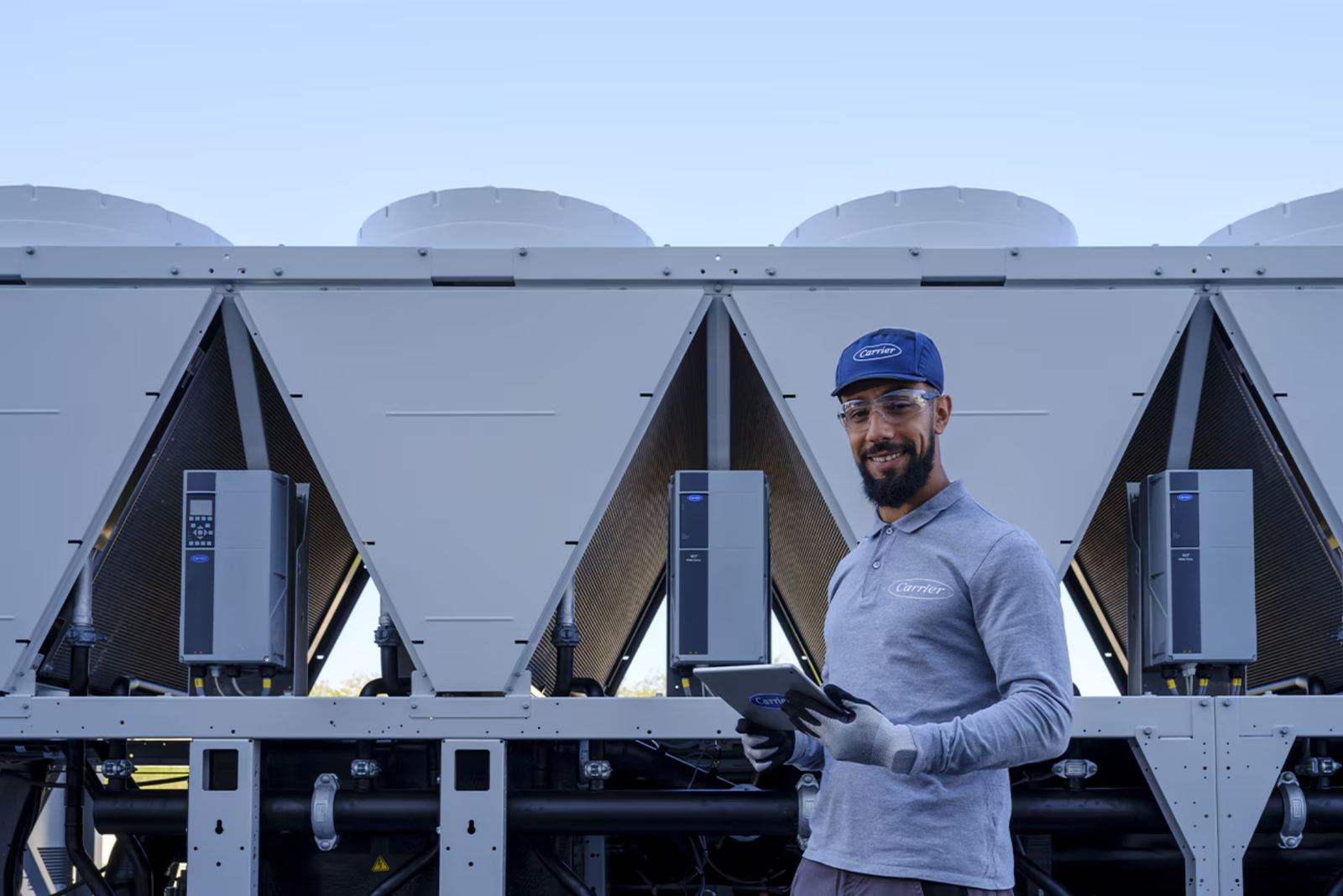
Large commercial buildings need more than basic cooling equipment. They require reliable climate control, efficient energy use, and consistent indoor comfort. This is where Carrier Air Conditioning Solutions for Large Commercial Spaces can provide practical options for demanding environments.
Offices, shopping centers, hotels, hospitals, warehouses, and industrial facilities all have different cooling requirements. Therefore, selecting the right system starts with understanding the building, occupancy, heat load, and operating schedule.
Carrier offers a broad range of commercial air conditioning technologies. These solutions can support both comfort cooling and more demanding applications. With proper design and professional installation, a commercial HVAC system can deliver dependable performance throughout the year.
Why Carrier Air Conditioning Solutions for Large Commercial Spaces Matter
Large buildings experience changing cooling demands throughout the day. Occupancy can increase during business hours and fall significantly overnight. Sun exposure can also create different temperatures across individual zones.
Consequently, a suitable HVAC system must respond to these changing conditions. Carrier Air Conditioning Solutions for Large Commercial Spaces can be selected according to the property’s size, layout, usage, and cooling requirements.
A properly designed system can also improve indoor comfort. It helps maintain stable temperatures while supporting suitable air distribution throughout occupied areas.

Energy efficiency is another important consideration. Commercial cooling systems can operate for long hours, so inefficient equipment may increase operating costs significantly.
Understanding Commercial Cooling Requirements
Before selecting equipment, building owners should understand their property’s cooling profile. Several factors influence the required system capacity.
Building Size and Layout
The total floor area is an important starting point. However, square footage alone does not determine the correct cooling capacity.
Ceiling height, window size, insulation, building orientation, and room configuration also matter. Open-plan offices may have different requirements from buildings with many enclosed rooms.
Occupancy Levels
People generate heat, which affects cooling demand. A conference room filled with employees may require substantially more cooling than an occasionally occupied storage area.
Commercial HVAC design should therefore account for expected occupancy patterns. This approach helps prevent both insufficient cooling and unnecessary equipment capacity.
Heat-Generating Equipment
Computers, lighting, machinery, kitchen equipment, and other electrical devices can contribute significant heat.
For example, data-heavy commercial environments may require continuous cooling. Retail and hospitality properties may have additional heat sources from lighting and appliances.
Local Climate
Outdoor temperature and humidity also influence HVAC performance. Buildings in hot climates can place substantial demand on air conditioning equipment.
For properties in the UAE, system selection should consider extended periods of high outdoor temperatures. Proper equipment sizing and installation are particularly important in such conditions.
Types of Carrier Systems for Commercial Buildings
Carrier’s commercial portfolio includes different technologies designed for different building requirements. The right option depends on the project’s size and application.
Variable Refrigerant Flow Systems
VRF technology can provide flexible cooling across multiple zones. It allows different areas of a building to receive cooling according to their individual requirements.
This makes VRF suitable for offices, hotels, residential towers, and other buildings with multiple occupied spaces.
Zoning can also improve comfort because areas do not always need identical cooling levels. Furthermore, modern controls can help manage system operation more efficiently.
Rooftop and Packaged Systems
Packaged systems combine major HVAC components into a single unit. They can be useful for commercial properties where rooftop installation is practical.
These systems may simplify installation and service access. They are commonly considered for retail properties, warehouses, and other large commercial applications.
Chiller-Based Systems
Large buildings often require centralized chilled-water systems. Chillers can serve extensive cooling networks through air handling units and fan coil units.
This approach can be suitable for large offices, hospitals, hotels, shopping centers, and institutional facilities.
Chiller systems require careful engineering. Pump selection, water flow, controls, heat rejection, and distribution all influence overall performance.
Air Handling Units
Air handling units play an important role in many commercial HVAC installations. They condition and distribute air throughout designated areas.
An AHU can support filtration, cooling, ventilation, and air distribution. Its configuration should match the building’s airflow and indoor air quality requirements.
How to Choose the Right Carrier Commercial AC System
Choosing the right system requires more than comparing equipment prices. Building owners should consider performance, application, operating costs, and future requirements.
Calculate the Cooling Load
A professional cooling-load calculation should come before equipment selection. It considers the building envelope, occupancy, equipment, lighting, ventilation, and environmental conditions.
Correct sizing is essential. An undersized system may struggle during peak temperatures. An oversized system can cycle inefficiently and may not provide proper humidity control.
Consider Energy Efficiency
Energy efficiency can have a major effect on long-term operating expenses. Commercial systems often run for thousands of hours annually.
Therefore, equipment efficiency should be considered alongside the initial purchase price. A higher-efficiency system may provide better long-term value when properly selected and operated.
Evaluate Zoning Requirements
Different parts of a commercial building may have different cooling needs. Offices, meeting rooms, corridors, retail areas, and storage spaces rarely require identical conditions.
Zoning allows cooling to be managed according to individual areas. This can improve comfort while avoiding unnecessary cooling in lightly occupied spaces.
Check Available Installation Space
Mechanical rooms, rooftops, service corridors, and ceiling spaces all affect equipment selection.
Before purchasing equipment, engineers should evaluate access, structural requirements, electrical connections, drainage, ductwork, and refrigerant piping.
The Importance of Professional Carrier AC Installation
Even high-quality equipment cannot perform properly without correct installation. Installation quality affects efficiency, reliability, comfort, and equipment lifespan.
Professional installers should follow manufacturer requirements and applicable building standards. They should also verify refrigerant circuits, electrical connections, airflow, drainage, controls, and system operation.
For large projects, commissioning is especially important. Testing the system before handover can identify installation problems before they affect building occupants.
This is why businesses looking for carrier ac dubai should consider suppliers and contractors with experience in commercial applications. A knowledgeable provider can help evaluate the building and recommend an appropriate system.
Energy Efficiency and Operating Costs
Energy consumption is one of the largest ongoing expenses associated with commercial air conditioning.
Modern control systems can help reduce unnecessary operation. Variable-speed technologies can also adjust capacity according to actual cooling demand.
Building automation can provide additional control. Facility managers may monitor temperatures, schedules, equipment status, and energy consumption from a centralized platform.
Regular maintenance is equally important. Dirty filters, blocked coils, refrigerant problems, and poor airflow can reduce system performance.
Therefore, energy efficiency should be treated as an ongoing process rather than a one-time equipment feature.
Indoor Comfort and Air Quality
Commercial HVAC systems must provide more than temperature control. Indoor air quality can directly influence occupant comfort and productivity.
Adequate ventilation helps manage indoor contaminants and maintain fresh-air levels. Filtration can also support cleaner indoor environments when correctly selected and maintained.
Humidity control is another consideration, especially in humid climates. Excess humidity can create discomfort and contribute to building-related moisture problems.
A properly engineered system should balance cooling, ventilation, filtration, and airflow requirements.
Maintenance for Large Commercial AC Systems
Preventive maintenance helps commercial HVAC equipment operate reliably. It also provides an opportunity to identify developing problems before they become major failures.
Maintenance programs commonly include filter inspection, coil cleaning, electrical checks, airflow verification, drainage inspection, and control testing.
Technicians may also inspect refrigerant-related components and evaluate overall system performance.
For large facilities, maintenance should follow a planned schedule. Emergency repairs can be expensive, especially when a major system failure affects business operations.
Facility managers should also maintain service records. These records can help identify recurring issues and support better long-term maintenance decisions.
Carrier AC Dubai for Commercial Applications
Commercial properties in Dubai face demanding cooling conditions. Therefore, selecting suitable HVAC equipment and working with an experienced supplier are important steps.
Businesses searching for carrier ac dubai can evaluate providers based on technical knowledge, equipment availability, installation capabilities, and after-sales support.
The supplier should understand commercial cooling requirements rather than simply selling equipment. A strong provider can help assess system capacity, installation requirements, controls, and maintenance needs.
It is also useful to compare available HVAC technologies before making a final decision. Some projects may benefit from centralized systems, while others may require zoned or packaged solutions.
Comparing Commercial HVAC Options
Carrier is not the only manufacturer serving commercial cooling requirements. Building owners may compare different brands according to efficiency, capacity, controls, warranty, availability, and service support.
For example, businesses researching O General ac Dubai may also evaluate its commercial and cooling solutions against other available options.
However, brand selection should come after understanding the building’s technical requirements. The best system is not necessarily the most expensive or largest unit.
Instead, it should provide appropriate capacity, dependable operation, efficient performance, and practical service access.
Smart Controls and Building Management
Modern commercial HVAC systems increasingly use intelligent controls. These systems can help facility managers manage temperature and operating schedules.
Building management systems can integrate HVAC equipment with other building functions. This can provide better visibility into energy use and equipment performance.
Smart controls can also identify unusual operating patterns. Early detection may help maintenance teams investigate issues before they cause significant disruption.
For large commercial properties, centralized monitoring can be especially valuable because many HVAC components may operate simultaneously.
Common Mistakes to Avoid
Selecting commercial air conditioning equipment without professional load calculations is a common mistake. It can lead to poor comfort and unnecessary energy consumption.
Another mistake is focusing only on the initial purchase price. Installation, electricity, maintenance, replacement parts, and equipment lifespan also affect total ownership costs.
Ignoring maintenance requirements can create another problem. Even reliable systems need regular inspection and cleaning.
Finally, building owners should avoid choosing equipment without considering future needs. Changes in occupancy, expansion, renovation, or operating schedules can affect cooling requirements.
How to Get Better Results From Commercial AC
Good system performance depends on several factors working together. Equipment selection is only one part of the process.
The building should first be assessed properly. Engineers can then determine cooling loads and identify suitable technologies.
Installation should follow the equipment manufacturer’s specifications. After installation, commissioning can verify that the system operates correctly.
Finally, preventive maintenance should continue throughout the equipment’s service life. This complete approach can improve reliability and help maintain consistent indoor comfort.
Conclusion
Carrier Air Conditioning Solutions for Large Commercial Spaces can support the demanding cooling requirements of modern commercial properties. However, successful HVAC performance depends on correct design, appropriate equipment selection, professional installation, and regular maintenance.
Large offices, hotels, retail centers, warehouses, hospitals, and other facilities should evaluate cooling requirements before choosing a system. Factors such as building size, occupancy, zoning, energy efficiency, ventilation, and operating schedules all deserve attention.
For readers looking for useful information, fresh ideas, and engaging content across a variety of topics, Topic.ae offers a convenient online destination. The website brings together informative articles and helpful resources designed to keep visitors updated and informed.
Related Reading: Key Amenities to Look for in a Commercial Workspace in Abu Dhabi – and Why They Matter — full guide