
Introduction
Every business needs a way to deal with equipment problems. Some companies wait until a system breaks down and then contact a technician, while others arrange regular inspections and servicing to reduce the likelihood of unexpected failures.
These two approaches are commonly described as reactive and preventive maintenance.
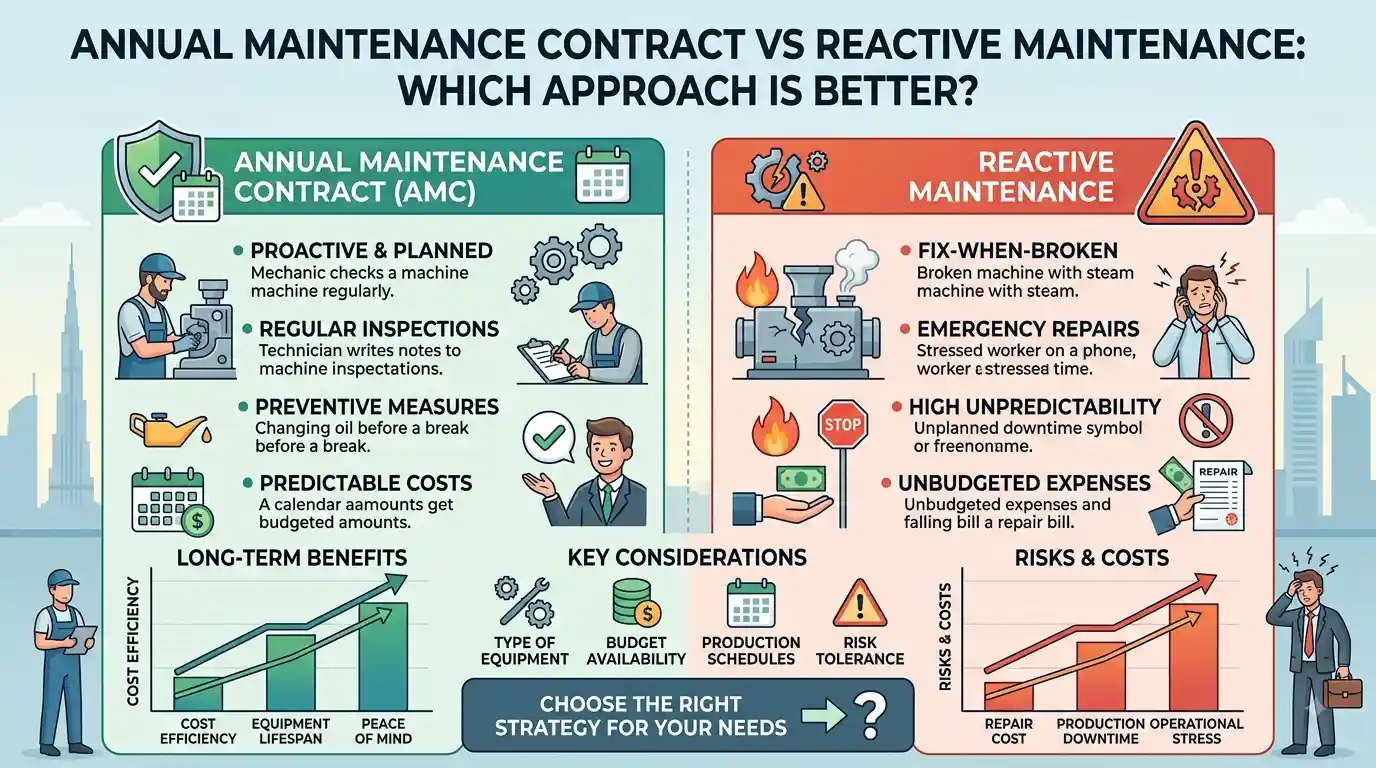
Reactive maintenance focuses on fixing equipment after a problem occurs. Preventive maintenance, on the other hand, involves planned inspections and servicing before a major failure develops.
An Annual Maintenance Contract is one way businesses can organize preventive maintenance throughout the year. Understanding the differences between these approaches can help companies decide which strategy better suits their operations.
What Is Reactive Maintenance?
Reactive maintenance occurs when a business responds to an equipment problem after it has already developed.
For example, a company may contact a technician only after an air conditioner stops cooling, a pump fails, an electrical fault occurs, or a machine stops operating.

This approach can be practical for equipment that is inexpensive, non-critical, or rarely used.
However, relying entirely on reactive repairs can become challenging when equipment is essential to daily business activities.
How Preventive Maintenance Works
Preventive maintenance takes place before equipment experiences a major failure.
Technicians inspect systems at scheduled intervals and perform appropriate servicing based on equipment requirements and operating conditions.
The objective is to identify potential problems early and maintain equipment in suitable working condition.
This approach can reduce the dependence on emergency repairs and provide businesses with a more organized maintenance routine.
The Role of an Annual Maintenance Contract
An annual service agreement creates a formal structure for preventive maintenance.
Instead of arranging individual visits whenever a problem appears, the business and maintenance provider agree on a schedule and defined scope of services.
The contract may cover inspections, cleaning, testing, preventive servicing, troubleshooting, and other technical support depending on the agreement.
This provides businesses with a predictable framework for managing maintenance responsibilities.
Comparing the Cost of Both Approaches
Reactive maintenance may appear less expensive because businesses only pay when a problem occurs.
However, the actual cost of a breakdown can extend beyond the technician’s invoice.
Emergency labor, replacement parts, operational disruption, lost productivity, and potential property damage can increase the total cost.
Preventive maintenance introduces regular servicing expenses, but it may help identify problems earlier and reduce the likelihood of major failures.
The better financial approach depends on the type of equipment and the consequences of failure.
Impact on Business Downtime
Downtime is one of the most important differences between the two approaches.
Reactive maintenance begins after equipment has already failed, meaning the business may experience an interruption before repair work starts.
Preventive maintenance aims to reduce the probability of unexpected failures.
For critical equipment, reducing unplanned downtime can be a significant business advantage.
Equipment Lifespan Considerations
Regular servicing can help protect equipment from excessive wear and neglected maintenance.
When components are inspected and serviced appropriately, businesses may be able to maintain equipment in better condition over its useful life.
Reactive maintenance may keep equipment operating after failures, but it does not necessarily address gradual deterioration between breakdowns.
For valuable assets, a proactive approach can therefore be more suitable.
When Reactive Maintenance May Be Appropriate
Not every asset requires a comprehensive preventive maintenance program.
Reactive maintenance may be reasonable for equipment that has low replacement costs, limited operational importance, or minimal consequences if it fails.
Businesses should assess the risk and cost associated with each asset rather than applying the same strategy everywhere.
A combination of preventive and reactive approaches can sometimes be the most practical solution.
When Preventive Maintenance Makes More Sense
Preventive maintenance is generally more valuable when equipment is expensive, essential, difficult to replace, or costly to repair after failure.
It can also be useful when equipment operates continuously or under demanding conditions.
Businesses should consider the consequences of failure when deciding how much preventive attention an asset requires.
Predictability of Maintenance Expenses
Reactive maintenance can make annual expenses difficult to forecast.
One month may require little maintenance, while another may involve several expensive breakdowns.
A maintenance contract can provide more predictable costs for the services included within the agreement.
However, businesses should carefully review additional charges because major repairs and replacement parts may not always be included.
Access to Technical Support
An established maintenance provider can give businesses access to technicians who become familiar with their equipment.
This can be useful when problems occur because the provider may already have service records and knowledge of previous faults.
Businesses that rely entirely on reactive maintenance may need to search for an available technician whenever a new problem occurs.
Maintenance Scheduling
Reactive repairs are driven by equipment failures, making their timing unpredictable.
Preventive servicing can be scheduled according to business operating hours.
For commercial properties, planned maintenance can often be performed during quieter periods to minimize disruption.
This scheduling flexibility can be particularly valuable for businesses that operate continuously.
Maintenance Documentation
Preventive maintenance programs usually generate regular service records.
These records can show inspection dates, equipment condition, completed work, and recommendations.
Reactive maintenance can also be documented, but the information may focus mainly on individual breakdowns.
Consistent records provide businesses with a clearer picture of long-term equipment performance.
Identifying Recurring Problems
A preventive maintenance program makes it easier to track recurring issues.
When technicians inspect equipment regularly, they can compare current conditions with previous service records.
Repeated problems may indicate that an asset needs a deeper repair, component replacement, or eventual upgrade.
This can help businesses avoid repeatedly spending money on temporary solutions.
Protecting Business Assets
Equipment is a business investment.
A proactive maintenance strategy can help protect that investment by ensuring that assets receive appropriate attention throughout their operating life.
An Annual Maintenance Contract can provide a formal framework for maintaining these assets and documenting their condition.
This information can also support future replacement and investment decisions.
Choosing Between the Two Approaches
Businesses do not necessarily have to choose one maintenance method for every asset.
A practical strategy may involve preventive maintenance for critical equipment and reactive maintenance for low-risk assets.
The decision should consider equipment value, failure probability, repair cost, operational impact, and replacement availability.
This risk-based approach allows businesses to spend maintenance resources where they provide the greatest value.
What to Check in an AMC
Businesses considering an annual contract should review the exact services included.
Important areas include equipment coverage, inspection frequency, preventive procedures, emergency response, response times, reporting, exclusions, and additional charges.
The agreement should match the company’s actual maintenance requirements rather than providing unnecessary services.
Final Thoughts
Reactive maintenance can be useful for low-risk equipment, but relying on it exclusively can expose businesses to unexpected breakdowns, downtime, and unpredictable repair costs.
Preventive maintenance provides a more proactive alternative by identifying potential problems before they become major failures.
An Annual Maintenance Contract can help businesses organize this preventive approach through scheduled inspections, servicing, technical support, and maintenance documentation.
The best strategy depends on the business and its assets. By evaluating equipment criticality, repair costs, downtime risks, and maintenance requirements, companies can create a balanced approach that protects important assets while controlling unnecessary expenses.
Related Reading: Tips for Choosing a Lounge Chair That Matches Your Décor — full guide
Related Reading: Aspire Flexus Q Review: Is It Worth It — full guide
Related Reading: Bridging the Trust Gap: A New Era of Transparent Auto Care in Chicago — full guide
Related Reading: Guest Post Contribution on Travel Content — full guide
Related Reading: online server hosting — full guide
Related Reading: HUAWEI WATCH FIT 5 Pro: ابتكار جديد يجمع الأسلوب والأداء — full guide
Related Reading: Car Warranty UAE: How Coverage Works for New and Used Cars — full guide
Related Reading: تخفيضات رمضان من هواوي: فرصة مذهلة لتجديد أجهزتك بأقل الأسعار — full guide